

 Deutsch
Continuing education | Lifelong learning | Age-inclusive | AliVe | Multiplier event |
Documentation
This was AliVe
At the IARA research colloquium on 19 August 2026, which was also the AliVe multiplier event and the project’s closing, we were given an exciting summary of all the findings from the three-year research project on age-inclusive lifelong learning.
There was a touch of wistfulness amongst the international project consortium comprising four universities from four countries (Austria, Finland, Ireland and the Czech Republic), given that this exceptionally fruitful collaboration is now drawing to a close. The project was strongly characterised by intensive collaboration with all stakeholders and the target groups of people aged 55 and over, and above all by the enriching experience of learning from and with one another. There was not a single person who had not learnt something new. Project leader Christine Dullnig-Pichler from Carinthia University of Applied Sciences, on behalf of all consortium partners (Karelia University of Applied Sciences, University College Cork, Charles University), therefore extended a huge thank you to all those involved in the project who contributed their expertise and experience.
What are the key findings?
The core question of the project can be formulated as follows:
How can short continuing education programmes, known as ‘micro-credentials’, be designed to be age-inclusive? What are the needs, expectations and wishes in this regard? What needs to be taken into account?
Key findings presented by Christine Dullnig-Pichler and Stephanie Putz included, for example:
- It is important to build on the experiences and competencies of older learners and to draw upon them.
- Programmes must be flexible and easily accessible. Having a personal contact person is key.
- Interest in lifelong learning is generally very high.
- Thematic interests primarily include the following topics: health, history and culture, languages, social sciences and technology.
- (Weekly) face-to-face courses are far more preferred than online courses.
- The motivations for learning are primarily personal: individual development is considered far more important than professional training. A significant discrepancy can be observed here between public discourse and the needs of the target groups.
- The framework conditions for continuing education (e.g. university education, financing) for older people vary greatly from country to country.
- The diversity of people aged 55 and over must be taken into account. People over 80 have very different needs to younger generations.
The results were not developed for the target group, but were consistently developed in collaboration with the target group or groups throughout the entire project via numerous workshops, focus groups and surveys.
Publication of the Guidelines for age-inclusive lifelong learning
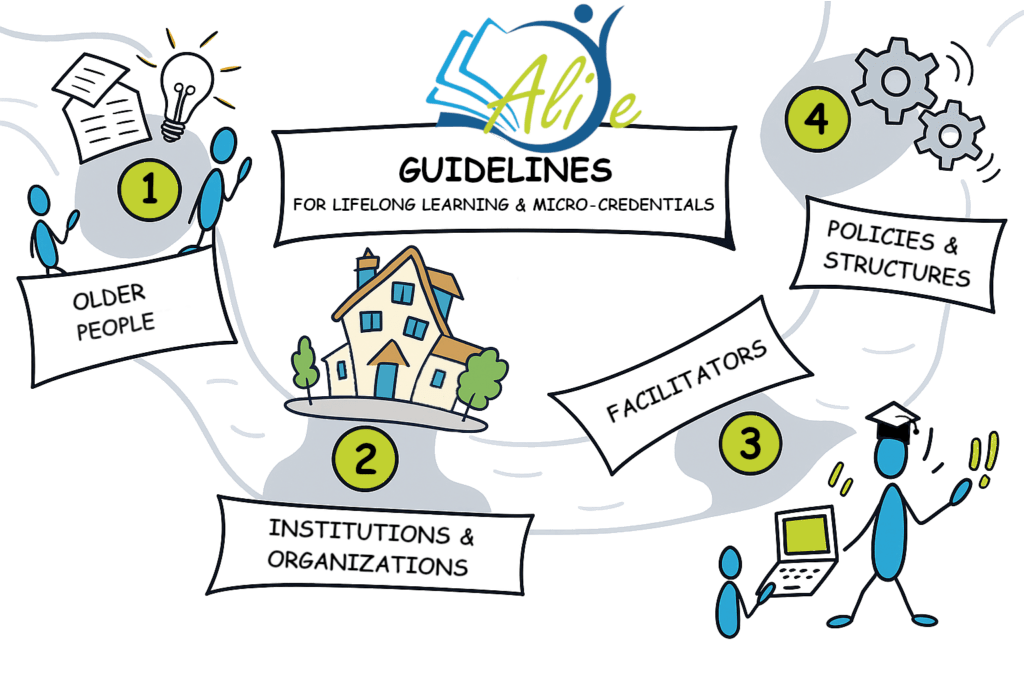
THE outcome of the AliVe project, which is now available online, is a Handbook for planning and implementing educational programmes for people aged 55 and over (available in the 4 project languages).
It ensures that all the findings gained through the AliVe project are shared with all stakeholders: older learners, institutions and organisations, facilitators, as well as policymakers and public administrators. It contains clear recommendations and relevant insights for each group. Furthermore, the recommendations in the handbook can be applied to many other social contexts and groups.
In short: there are many starting points for follow-up projects and further research questions. We can look forward to seeing what further activities will be launched in the future on the basis of the AliVe project.
Would you like to find out more?
Click here for the Handbook (AliVe Guidelines) and the AliVe project website:
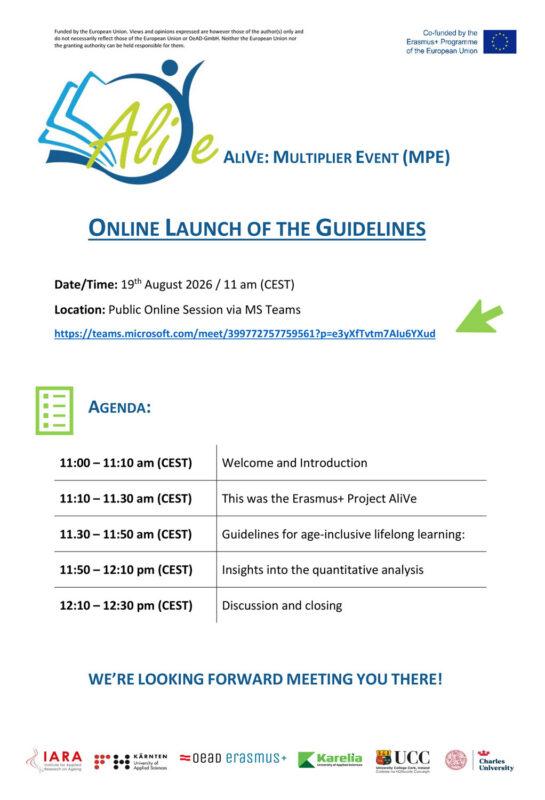
The next IARA Research Colloquium will focus on the project ‘AliVe | Age-inclusive Lifelong Learning: Micro-Credentials and Guidelines’. As part of the colloquium, the final AliVe Multiplier Event will take place, as the Erasmus+ project comes to an end in August after a three-year run (2023–2026). However, the results are set to have a lasting impact. The project findings will be presented online, in English – in particular the guidelines and recommendations for age-inclusive lifelong learning for providers of continuing education opportunities for older adults. We warmly invite all those interested to take part.
Age-inclusive lifelong learning:
Presentation of the guidelines & AliVe project findings
Invitation (PDF)
As part of the IARA Research Colloquium
|
When | Wed, 19 August 2026, 11-12:30 CEST |
|
Where | Online via MS Teams |
|
No registration required | Meeting link |
This research colloquium will be held in English.
Meeting link (MS Teams)The IARA Research Colloquium is a forum for the presentation and discussion of research results and projects as well as for professional exchange.
| If you would like to receive invitations to IARA events by email, please subscribe to our mailing list. |
In English!
PROGRAMME
Please refer to the invitation below for the programme.